1. What is EventBridge?
Amazon EventBridge is a serverless event bus that connects applications using events. It receives events from sources (AWS services, custom apps, SaaS partners) and routes them to targets based on rules you define.
Core Concept EventBridge = the central nervous system of event-driven architectures on AWS. Events happen (EC2 instance stopped, S3 object created, custom app event) → EventBridge receives the event → rules evaluate it → matched events are routed to targets (Lambda, SQS, Step Functions, etc.). It replaces CloudWatch Events (same service, new name + more features).
2. Key Concepts
- Event Bus: A channel that receives events. Default bus (AWS events), custom buses (your events), partner buses (SaaS events).
- Event: A JSON object describing something that happened. Contains: source, detail-type, detail (payload), time, region, account, resources.
- Rule: Matches incoming events using an event pattern and routes them to targets. A rule can have up to 5 targets.
- Target: The destination that receives the matched event. 15+ AWS services supported as targets.
3. Event Sources
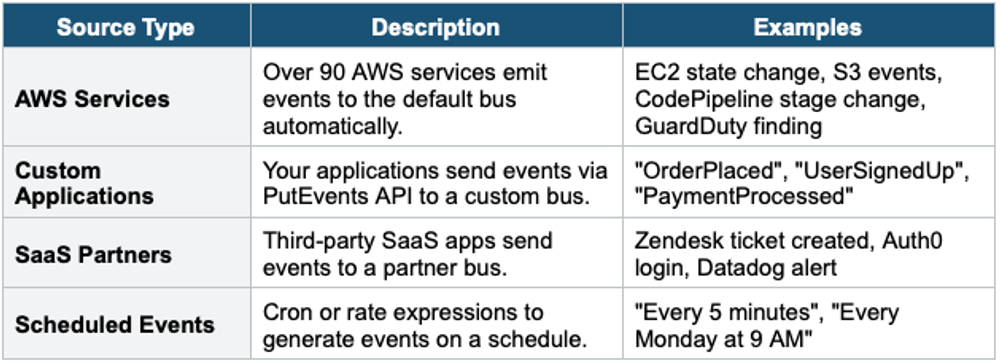
4. Event Targets
- Lambda function (most common)
- SQS queue, SNS topic
- Step Functions state machine
- Kinesis Data Streams, Kinesis Data Firehose
- ECS task, Batch job
- API Gateway, HTTP endpoint (API destination)
- CodePipeline, CodeBuild
- SSM Run Command, SSM Automation
- CloudWatch Log Group
- Another EventBridge bus (cross-account or cross-Region)
5. Event Pattern Matching
Event Pattern Example:

Match EC2 instance state changes to "stopped" or "terminated":
{
  "source": ["aws.ec2"],
  "detail-type": ["EC2 Instance State-change Notification"],
  "detail": {
    "state": ["stopped", "terminated"]
  }
}

Match custom order events over $100:
{
  "source": ["my-app.orders"],
  "detail-type": ["OrderPlaced"],
  "detail": {
    "amount": [{ "numeric": [">", 100] }]
  }
}
6. EventBridge Features
Schema Registry
- Automatically discovers and stores the schema (structure) of events
- Generates code bindings (Java, Python, TypeScript) for event structures
- Helps developers understand event formats without documentation
Archive & Replay
- Archive events to replay them later (for debugging, recovery, testing)
- Filter which events to archive using event patterns
- Replay archived events to any event bus
- Retention: indefinite or time-based
Cross-Account & Cross-Region
- Send events from one account’s bus to another account’s bus
- Send events from one Region to another Region
- Use for: centralized event processing, multi-account/multi-Region architectures
EventBridge Pipes
- Point-to-point integration between a source and a target
- Sources: SQS, Kinesis, DynamoDB Streams, Kafka
- Optional: filter events, enrich with Lambda/Step Functions/API, then deliver to target
- Simpler than rules for direct source-to-target piping
EventBridge Scheduler
- Create, run, and manage scheduled tasks at scale
- One-time or recurring schedules (cron/rate)
- Millions of schedules. Exactly-once delivery to targets.
- Replaces CloudWatch Events cron rules with more features
7. EventBridge vs SNS vs SQS
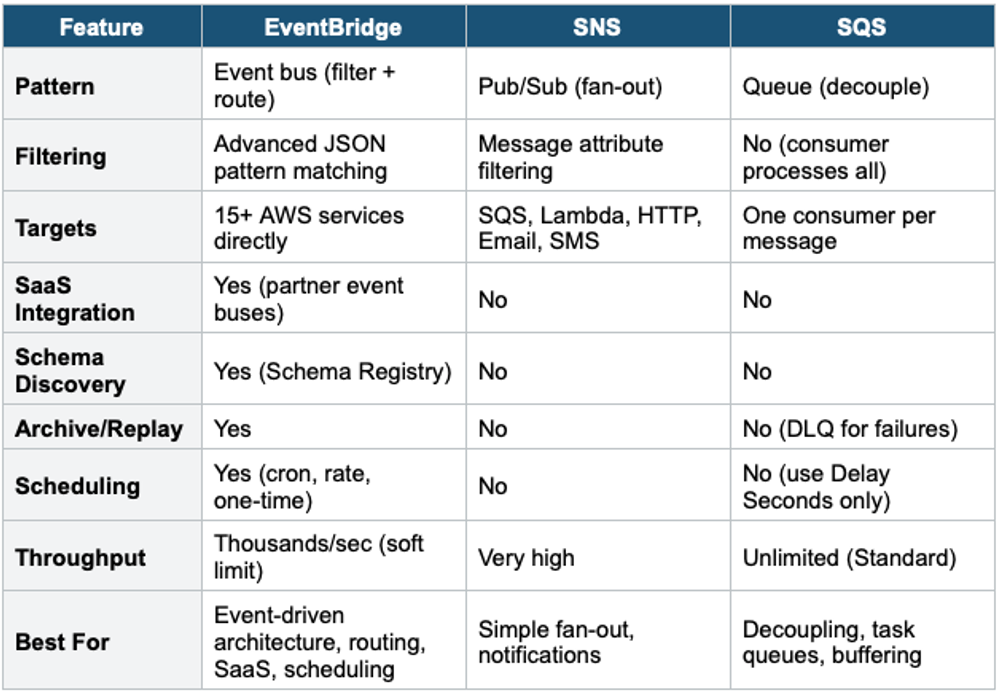
Exam Tip EventBridge: "Event-driven architecture" = EventBridge. "React to AWS service events" = EB (default bus). "Schedule a Lambda every 5 minutes" = EB Scheduler. "Replay past events" = EB Archive+Replay. "SaaS integration (Zendesk, Datadog)" = EB partner bus. "Simple fan-out to SQS queues" = SNS. "Decouple producer/consumer" = SQS. EventBridge is the modern recommended approach for event routing; SNS for simple fan-out; SQS for queuing.