1. What is Route 53?
Amazon Route 53 is a highly available, scalable, and authoritative DNS (Domain Name System) service. It translates domain names (e.g., example.com) into IP addresses. It also provides domain registration and health checking.
Why "Route 53"? DNS operates on port 53 (TCP/UDP). The name is also a reference to US Route 66 — a famous highway (routing). Route 53 provides three main functions: 1) DNS resolution (name → IP). 2) Domain registration (buy/manage domains). 3) Health checking (monitor endpoint availability).
2. DNS Record Types
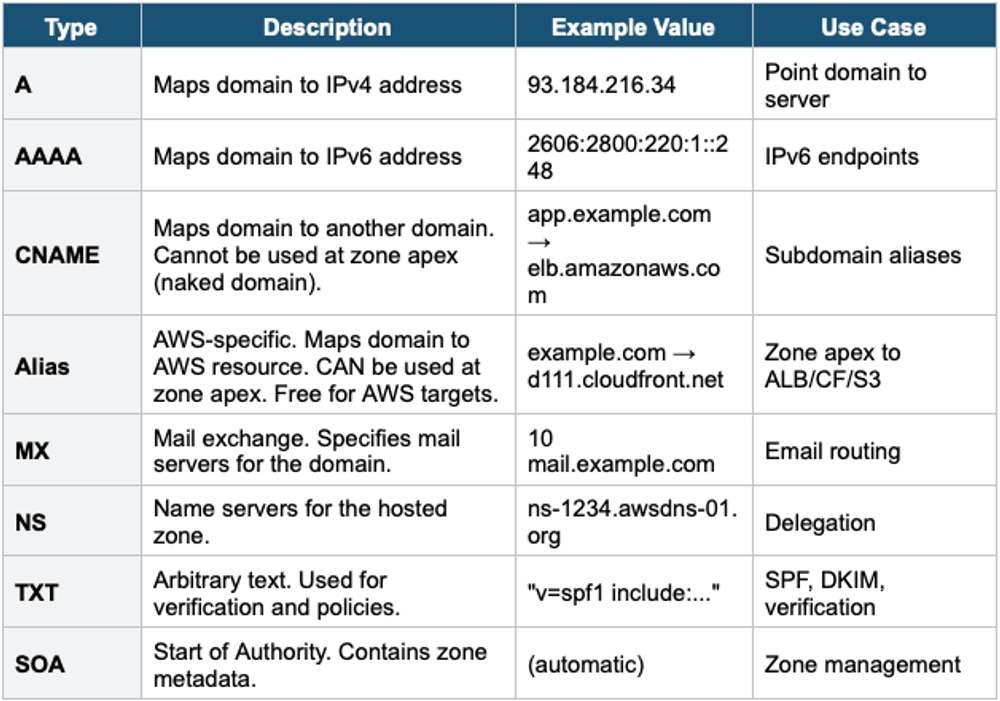
CNAME vs Alias CNAME: maps a name to another name. CANNOT be used at the zone apex (example.com). Costs money per query. Alias: AWS extension. Maps a name to an AWS resource. CAN be used at the zone apex. FREE for AWS targets (ALB, CloudFront, S3, API Gateway, etc.). Always use Alias when pointing to AWS resources.
Alias Record Targets
- ELB (ALB, NLB, CLB)
- CloudFront distribution
- API Gateway
- S3 website endpoint
- Elastic Beanstalk environment
- VPC Interface Endpoint
- Another Route 53 record in the same hosted zone
- CANNOT alias to an EC2 DNS name (use an A record instead)
3. Hosted Zones
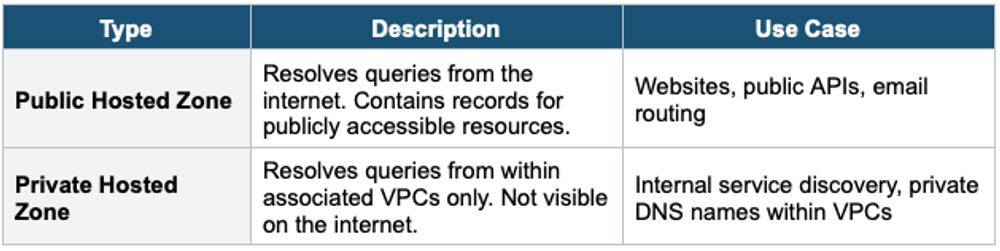
- $0.50/month per hosted zone
- A domain can have both public and private hosted zones (different answers for internal vs external)
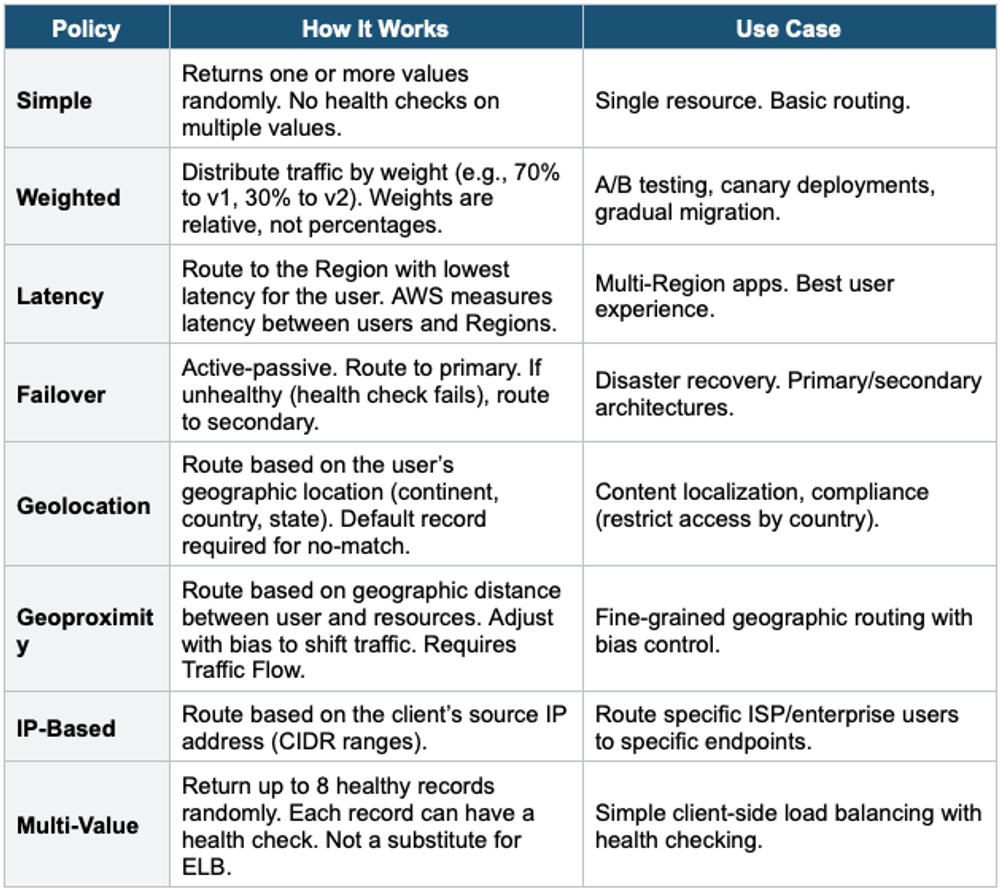
4. Routing Policies
5. Health Checks
- Monitor endpoint health (HTTP, HTTPS, TCP)
- Endpoint health checks: monitor an IP or domain (response code, response body string match)
- Calculated health checks: combine results of multiple health checks (AND, OR, NOT logic)
- CloudWatch Alarm health checks: based on CloudWatch alarm state
- Health checkers run from 15+ global locations (need to allow their IPs in your firewall)
- Unhealthy threshold: 3 consecutive failures (configurable)
- Check interval: 30 seconds (standard) or 10 seconds (fast, extra cost)
- Health checks for private resources: create CloudWatch alarm → health check monitors the alarm
Important Warning Route 53 health checkers are OUTSIDE your VPC. They cannot directly check private endpoints. For private resources: create a CloudWatch metric/alarm on the resource, then create a health check that monitors the CloudWatch alarm state.
6. Domain Registration
- Register domains directly through Route 53 (acts as a domain registrar)
- Supports common TLDs (.com, .org, .net) and many others
- Auto-creates a hosted zone for the registered domain
- You can also transfer existing domains to Route 53
- You can use Route 53 DNS with domains registered elsewhere (point NS records to Route 53)
Exam Tip Route 53: "Zone apex to ALB" = Alias record (not CNAME). "Lowest latency routing" = Latency policy. "Active-passive DR" = Failover policy. "A/B testing" = Weighted policy. "Restrict by country" = Geolocation policy. "Health check private resource" = CloudWatch alarm → health check. CNAME cannot be zone apex. Alias = free for AWS targets. $0.50/month per hosted zone.