1. What is the AWS Cloud Adoption Framework (CAF)?
The AWS Cloud Adoption Framework (CAF) is a comprehensive guide that helps organizations plan and execute their cloud migration. It organizes cloud transformation into six perspectives, covering both technical and business dimensions.
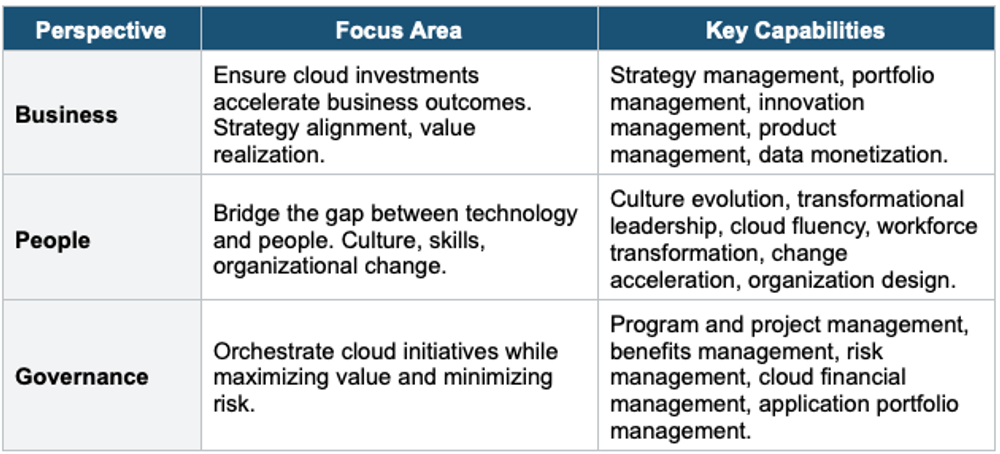
Core Concept The CAF ensures you don’t just move technology to the cloud — you transform the entire organization. It addresses: Why are we migrating? (business), Who needs new skills? (people), How do we govern? (governance), What platform do we build? (platform), How do we keep it secure? (security), How do we operate it? (operations). Six perspectives, three phases, four transformation domains.
2. Six CAF Perspectives
Business Perspectives (Stakeholders: C-suite, Business Leaders)
Technical Perspectives (Stakeholders: CTO, Architects, Engineers)
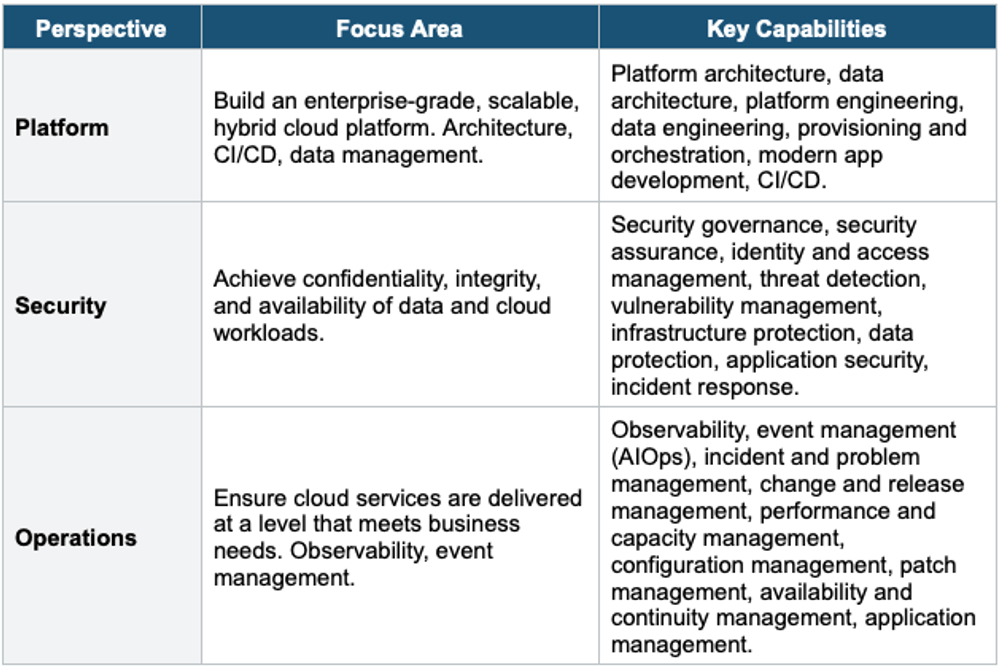
CAF Perspective Memory Trick Business perspectives (Business, People, Governance) = the WHY, WHO, and HOW of organizational transformation. Technical perspectives (Platform, Security, Operations) = the WHAT, HOW SAFE, and HOW WELL of cloud infrastructure. Exam: match the scenario to the perspective. "Upskill employees" = People. "Manage cloud costs" = Governance. "Build CI/CD pipelines" = Platform.
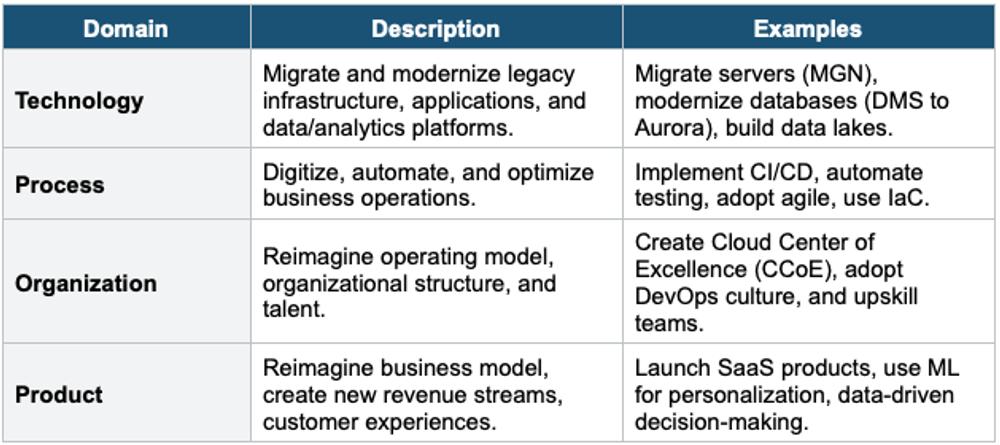
3. CAF Transformation Domains
The CAF identifies four transformation domains that the six perspectives address:
4. CAF Migration Phases
Cloud Migration Journey (3 Phases):

Phase 1: ENVISION
  • Identify transformation opportunities
  • Build business case for cloud migration
  • Quantify benefits (cost savings, agility, innovation)
  • Stakeholders: C-suite, Business Leaders
  • Output: Migration Business Case

Phase 2: ALIGN
  • Identify gaps across all 6 perspectives
  • Develop action plans for each perspective
  • Create a readiness assessment
  • Stakeholders: All teams
  • Output: Action Plans, Readiness Report

Phase 3: LAUNCH
  • Execute pilot migrations
  • Prove value and learn (iterate)
  • Scale to production migrations
  • Stakeholders: Technical teams
  • Output: Migrated workloads, lessons learned

Phase 4: SCALE (ongoing)
  • Expand to remaining workloads
  • Optimize and modernize
  • Continuous improvement
5. The 7 Rs Deep Dive
The 7 Rs define how each application should be migrated. This section provides a comprehensive deep dive into each strategy with decision criteria.
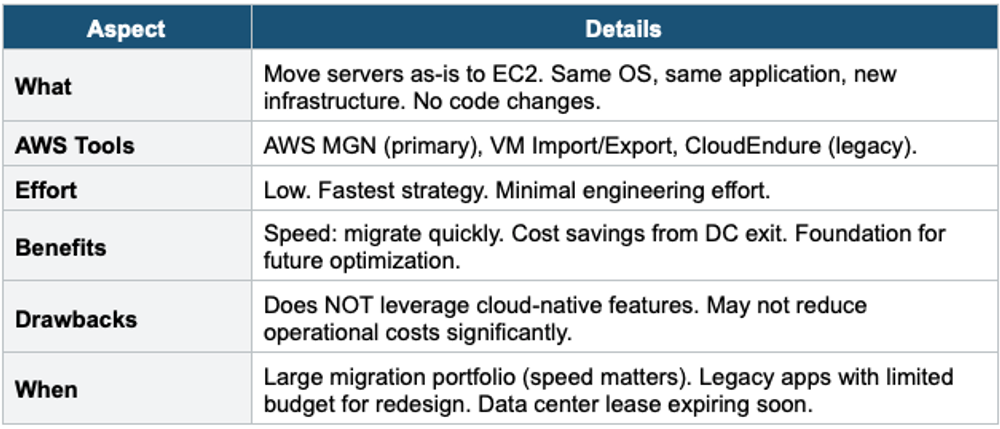
R1: Rehost (Lift & Shift)
R2: Replatform (Lift & Reshape)
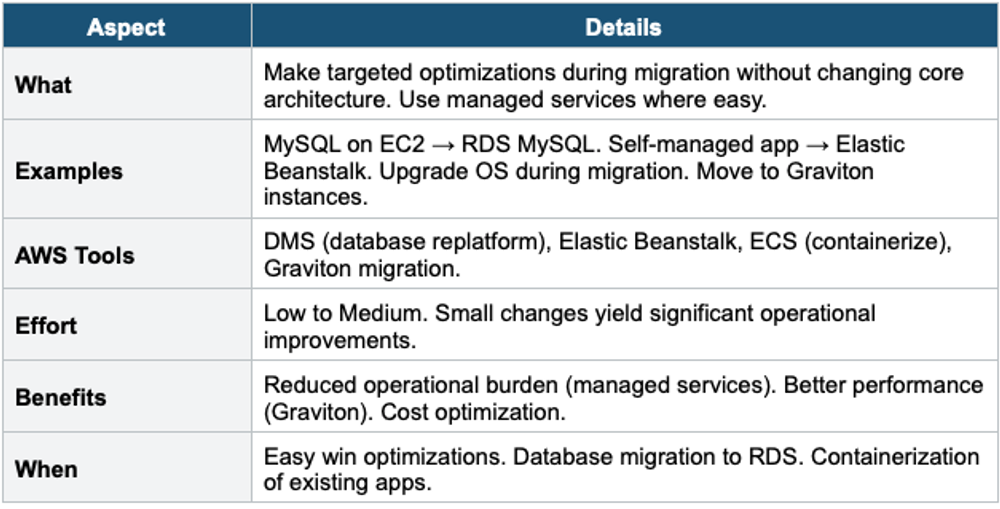
R3: Repurchase (Drop & Shop)
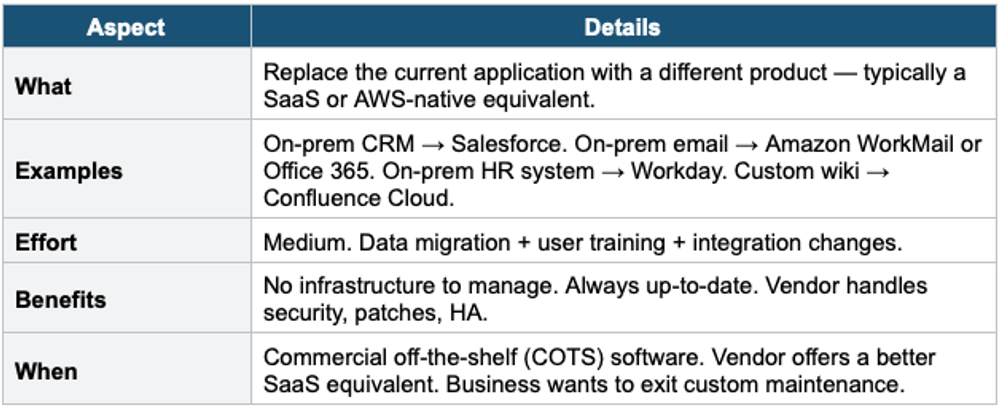
R4: Refactor / Re-architect
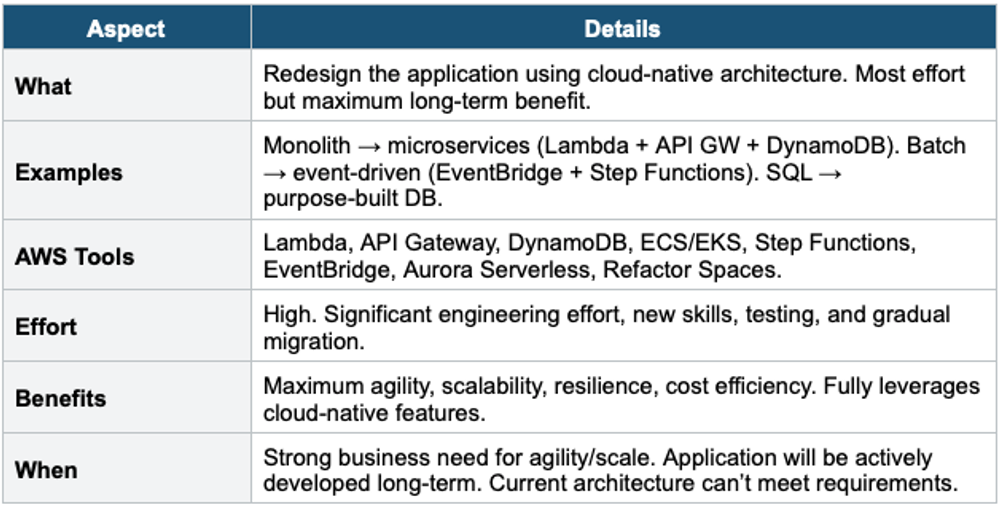
R5: Retire
- Decommission applications that are no longer needed
- Typical finding: 10–20% of an application portfolio is no longer useful
- Reduces: attack surface, licensing costs, operational burden, migration scope
- The discovery phase identifies retirement candidates
R6: Retain (Revisit)
- Keep applications on-premises for now. Not ready or not worth migrating yet.
- Reasons: deep dependencies, compliance restrictions, recent on-prem investment, not cost-effective to migrate
- Revisit periodically as cloud capabilities evolve
- Hybrid architecture: some on-prem + some in cloud (connected via VPN/Direct Connect)
R7: Relocate
- Move VMware-based workloads to VMware Cloud on AWS
- No changes to application, OS, or operations (same VMware tools)
- Use for: quick data center exit for VMware-heavy environments
- Not a deep cloud transformation (still VMware, just hosted on AWS infrastructure)
6. 7 Rs Decision Matrix
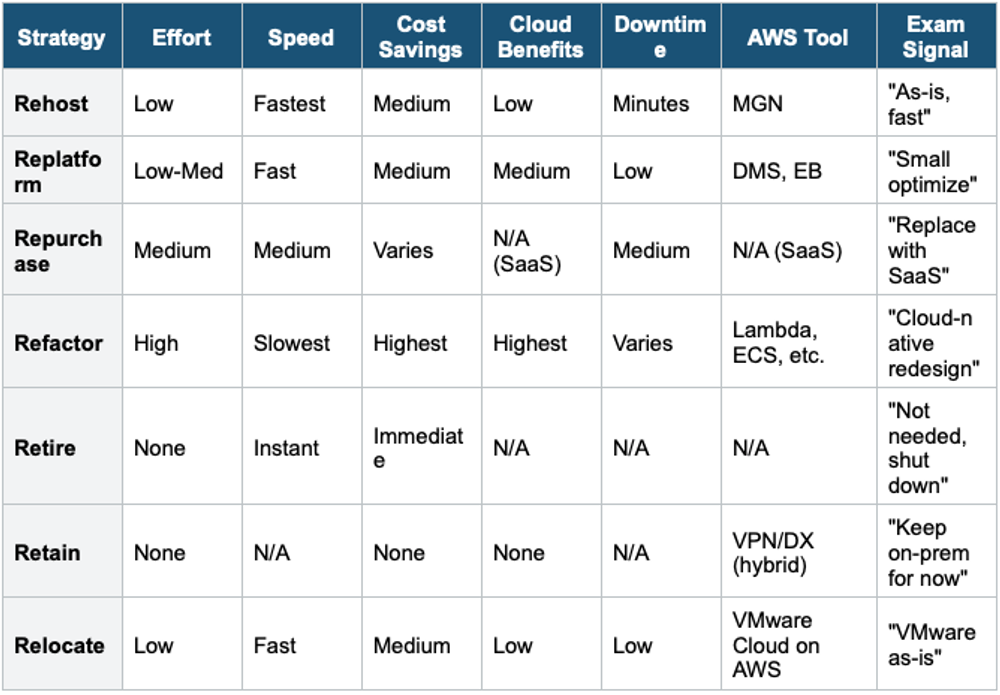
7. Migration Assessment Tools
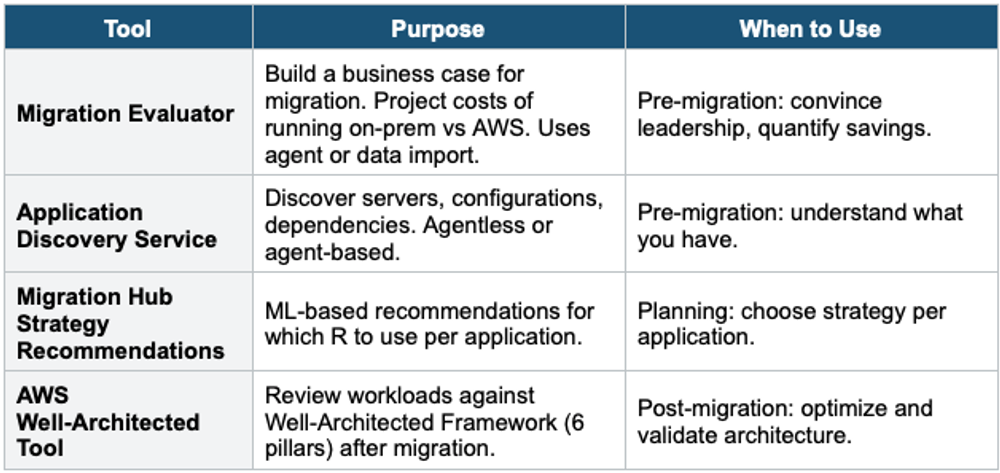
8. AWS Well-Architected Framework (Brief)
After migration, use the Well-Architected Framework to evaluate and improve your workloads:
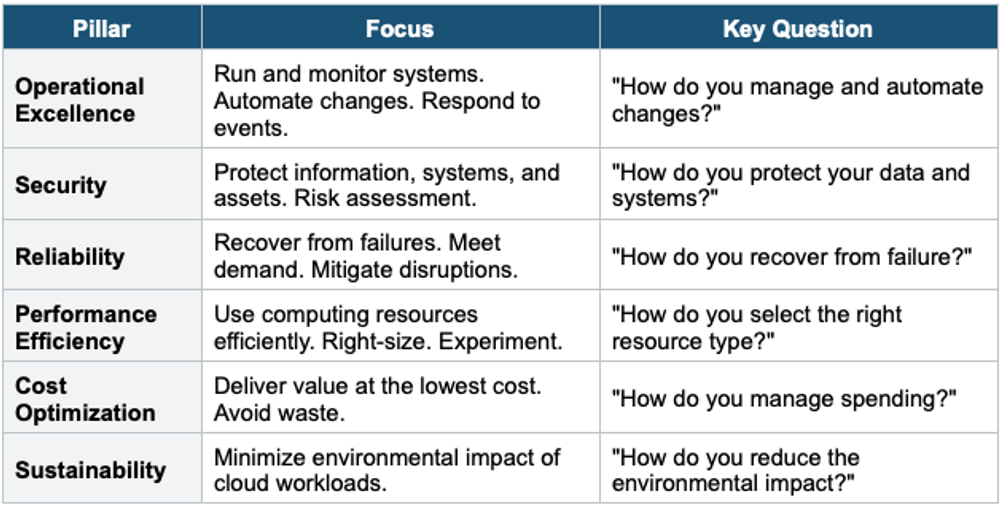
Well-Architected vs CAF CAF = pre-migration and migration planning (organizational transformation). Well-Architected = post-migration review and ongoing optimization (workload best practices). They complement each other: CAF gets you to the cloud, Well-Architected keeps you optimized once there.
9. Complete Migration Journey
End-to-End AWS Migration Journey:

1. ASSESS
   • Migration Evaluator: build business case
   • Application Discovery: inventory + dependencies
   • CAF Assessment: gaps across 6 perspectives

2. PLAN
   • Migration Hub Strategy Recommendations: choose Rs per app
   • 7 Rs: categorize every application
   • Prioritize: quick wins first (rehost), complex later (refactor)
   • Landing Zone: set up AWS accounts, networking, security (AWS Control Tower)

3. MIGRATE
   • Rehost: MGN (servers)
   • Replatform: DMS (databases), Elastic Beanstalk (apps)
   • Refactor: Lambda, ECS, DynamoDB (cloud-native rebuild)
   • Track: Migration Hub (single dashboard)

4. OPTIMIZE
   • Well-Architected Review: evaluate against 6 pillars
   • Cost Optimization: right-size, Savings Plans, Spot
   • Modernize: continue refactoring for cloud-native benefits
   • Automate: CI/CD, IaC, monitoring
Exam Tip CAF & 7 Rs: CAF has 6 perspectives: Business, People, Governance (business side) + Platform, Security, Operations (technical side). "Upskill employees" = People perspective. "Cloud financial management" = Governance. "Build CI/CD" = Platform. 7 Rs: "Fast as-is migration" = Rehost. "Use managed DB" = Replatform. "Replace with SaaS" = Repurchase. "Cloud-native redesign" = Refactor. "Shut down unused" = Retire. Well-Architected = 6 pillars for post-migration optimization (not the same as CAF).