1. Overview
Cloud service models define how much of the infrastructure stack is managed by the cloud provider versus the customer. Think of it as layers of responsibility.
The Pizza Analogy
Think of cloud models like getting pizza: IaaS = You buy ingredients and cook at home (you manage most things). PaaS = You buy a take-and-bake pizza (provider handles the oven/kitchen). SaaS = You order delivery (provider handles everything, you just eat).
2. Infrastructure as a Service (IaaS)
IaaS provides the fundamental building blocks of cloud IT. It gives you the highest level of flexibility and control over your IT resources.
What the provider manages: Hardware, networking, virtualization, physical data centers
What you manage: Operating system, middleware, runtime, data, applications
AWS IaaS Examples
- Amazon EC2 — Virtual servers
- Amazon VPC — Networking
- Amazon EBS — Block storage
- Amazon S3 — Object storage (can also be considered IaaS)
When to Use IaaS
- You need full control over the operating system
- You want to migrate existing on-premises applications to the cloud (Lift-and-Shift)
- You need custom networking or security configurations
3. Platform as a Service (PaaS)
PaaS removes the need to manage the underlying infrastructure (hardware, OS). You focus only on deploying and managing your applications.
What the provider manages: Hardware, networking, OS, middleware, runtime
What you manage: Application code and data
AWS PaaS Examples
- AWS Elastic Beanstalk — Deploy web applications without managing servers
- AWS Lambda — Run code without provisioning servers (also Serverless/FaaS)
- Amazon RDS — Managed relational databases
- Amazon DynamoDB — Managed NoSQL database
When to Use PaaS
- You want to focus on application code, not infrastructure
- You want faster development and deployment cycles
- You don’t need OS-level access
4. Software as a Service (SaaS)
SaaS is a complete product that is run and managed by the service provider. You don’t think about how the service is maintained or how the infrastructure is managed. You only use the software.
What the provider manages: Everything (infrastructure, platform, application)
What you manage: Your data and user settings only
AWS SaaS Examples
- Amazon WorkMail — Email and calendaring
- Amazon Chime — Video conferencing
- Amazon Connect — Contact center service
Non-AWS SaaS Examples (for context)
- Gmail, Microsoft 365, Salesforce, Dropbox, Zoom
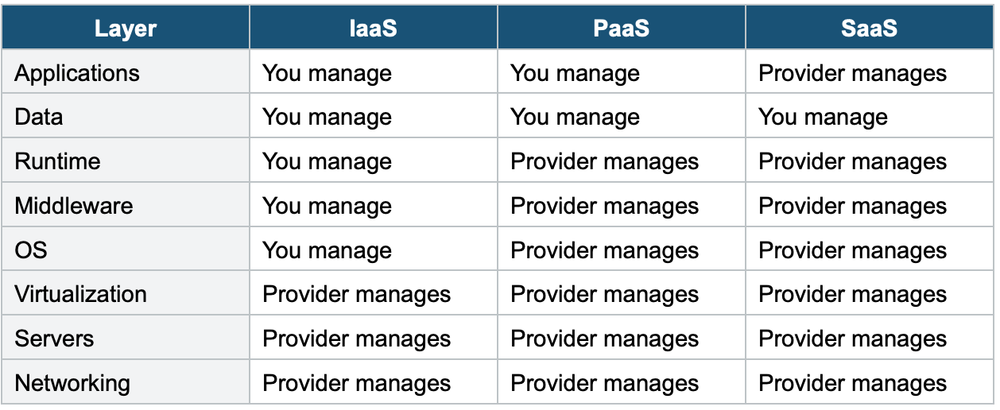
5. Service Models Comparison
6. Shared Responsibility in Each Model
The responsibility shifts from customer to provider as you move from IaaS to SaaS:
- IaaS: Customer has the most responsibility. Provider manages physical hardware only.
- PaaS: Provider manages more. Customer focuses on code and data.
SaaS: Provider manages almost everything. The customer manages data and user access.
Exam Tip
AWS exam often asks: "Which service model gives the customer the MOST control?" Answer: IaaS. "Which gives the LEAST control?" Answer: SaaS. Also remember that DATA is always the customer’s responsibility across all models.