1. DR Key Concepts
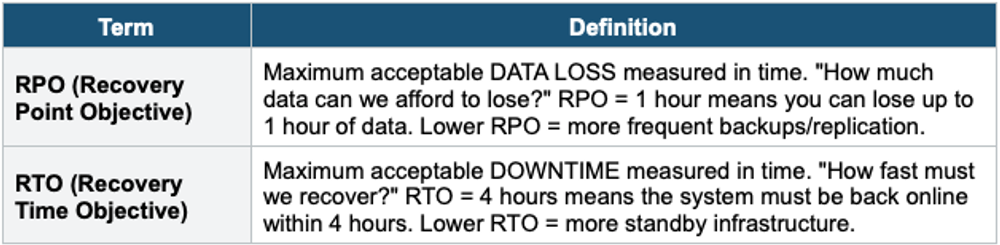
RPO vs RTO RPO = about DATA (how much you lose). RTO = about TIME (how long you’re down). A bank might need RPO = 0 (no data loss) and RTO = 15 minutes. A blog might accept RPO = 24 hours and RTO = 48 hours. Lower RPO/RTO = higher cost. The exam ALWAYS defines scenarios using RPO and RTO.
2. Four DR Strategies
AWS defines four DR strategies in order of cost and recovery speed. Each trade costs for faster recovery.
Strategy 1: Backup & Restore
Backup & Restore (Lowest Cost, Highest RTO):

Normal:  Primary Region is active. Backups stored in the DR Region.
         EBS snapshots, RDS snapshots, S3 CRR, AMIs copied.

Disaster: Primary Region fails.
  1. Restore from the latest backup in the DR Region
  2. Launch EC2 from AMIs
  3. Restore RDS from snapshot
  4. Update DNS to point to DR Region

RPO: Hours (depends on backup frequency)
RTO: Hours (time to restore + launch + configure)
Cost: Lowest ($$ for storage only, no running infra in DR)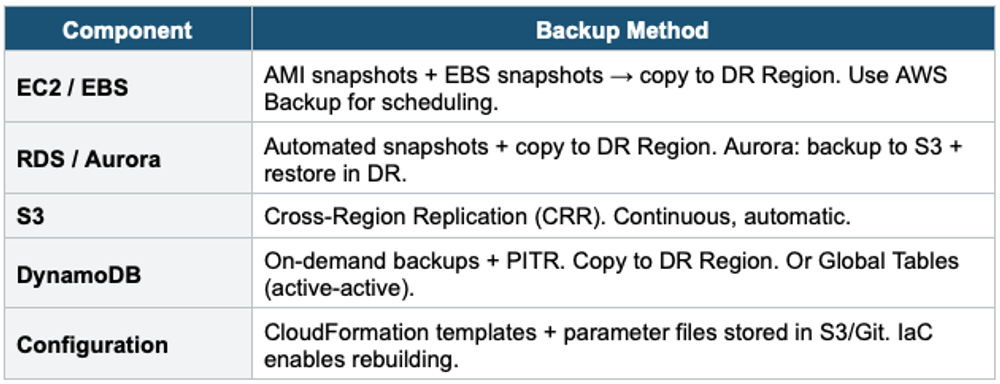
Strategy 2: Pilot Light
Pilot Light (Low Cost, Medium RTO):

Normal:  Primary Region fully active.
         DR Region: only CORE DATA infrastructure running
         (RDS replica, Aurora Global DB, S3 replication).
         Compute is OFF (no EC2, no ECS tasks).

Disaster: Primary Region fails.
  1. Data is already replicated (minimal RPO)
  2. Scale UP compute in DR: launch EC2/ECS from templates
  3. Scale up database (promote read replica)
  4. Update DNS to DR Region

RPO: Minutes (continuous data replication)
RTO: 10s of minutes (start compute + promote DB)
Cost: Low (pay for data replication + small DB, no compute)
Pilot Light Analogy Like a gas pilot light: a tiny flame (data replication) that’s always burning, ready to ignite the full system (compute) when needed. Data is always replicated. Computers are launched on-demand during a disaster.
Strategy 3: Warm Standby
Warm Standby (Medium Cost, Low RTO):

Normal:  Primary Region fully active.
         DR Region: SCALED-DOWN but RUNNING version of production.
         Smaller EC2 instances, fewer tasks, read replica promoted.
         Can handle some traffic (not full capacity).

Disaster: Primary Region fails.
  1. Scale UP DR Region to full production capacity
  2. Promote read replica to primary
  3. Route 53 failover: shift traffic to DR

RPO: Near-zero (continuous replication)
RTO: Minutes (scale up existing infra, no cold start)
Cost: Medium (running infra at reduced scale)
Strategy 4: Multi-Site Active-Active
Multi-Site Active-Active (Highest Cost, Lowest RTO):

Normal:  BOTH Regions are fully active, serving traffic simultaneously.
         Route 53 latency or weighted routing distributes users.
         Aurora Global Database, DynamoDB Global Tables.
         Both regions are at full capacity.

Disaster: One Region fails.
  1. Route 53 health check detects failure
  2. Traffic automatically routes to the surviving Region
  3. No manual intervention needed

RPO: Near-zero or zero (synchronous or fast async replication)
RTO: Near-zero (automatic failover, no scaling needed)
Cost: Highest (double infrastructure running at all times)
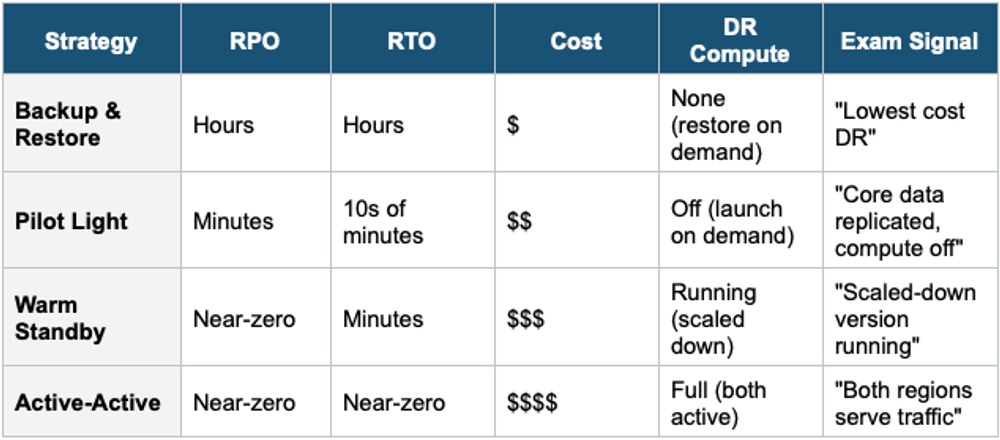
3. DR Strategy Comparison
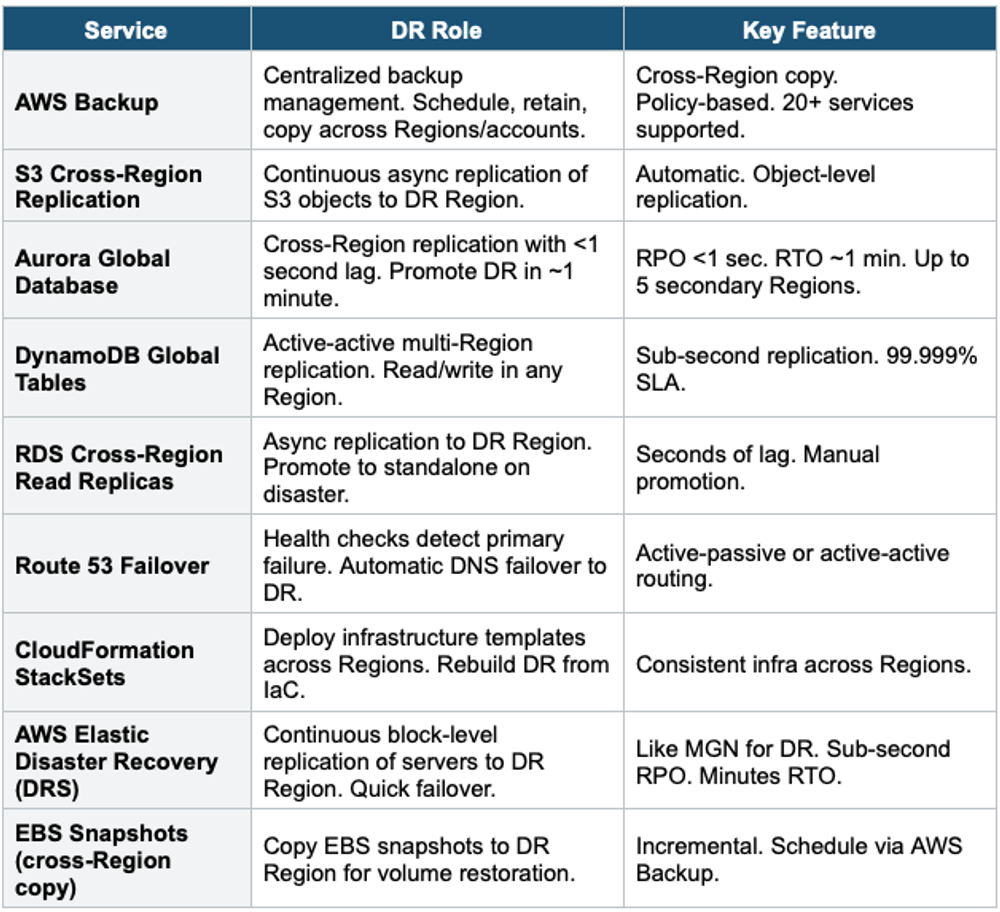
4. AWS DR Services
5. DR Architecture Patterns
Stateless Web Tier DR
Stateless Web Tier (easy DR):

  Primary: ALB → ASG (EC2) → stateless app
  State in: DynamoDB Global Tables + S3 CRR + ElastiCache

  DR: Launch ASG in the DR Region from the same Launch Template / AMI
      DynamoDB + S3 already replicated
      Route 53 failover redirects traffic

  Key: because the web tier is STATELESS, DR is just launching computers.
Database-Centric DR
Database DR Options:

  Aurora:    Global Database → promote secondary (<1 min RTO)
  RDS:      Cross-Region Read Replica → promote to primary
  DynamoDB: Global Tables (active-active, no failover needed)
  Redis:    Global Datastore → promote secondary cluster

  Tip: Aurora Global DB is the best DR option for relational workloads.
6. Testing DR
- Regular DR testing is critical — an untested DR plan is not a plan
- Table-top exercises: walk through DR steps without executing
- Simulation: test individual components (failover a database, restore from backup)
- Full DR drill: actually fail over to DR Region and run production from there
- Chaos engineering: randomly inject failures (AWS Fault Injection Service)
- Automate: use Step Functions to orchestrate DR failover steps
7. Exam Scenario Decision Guide
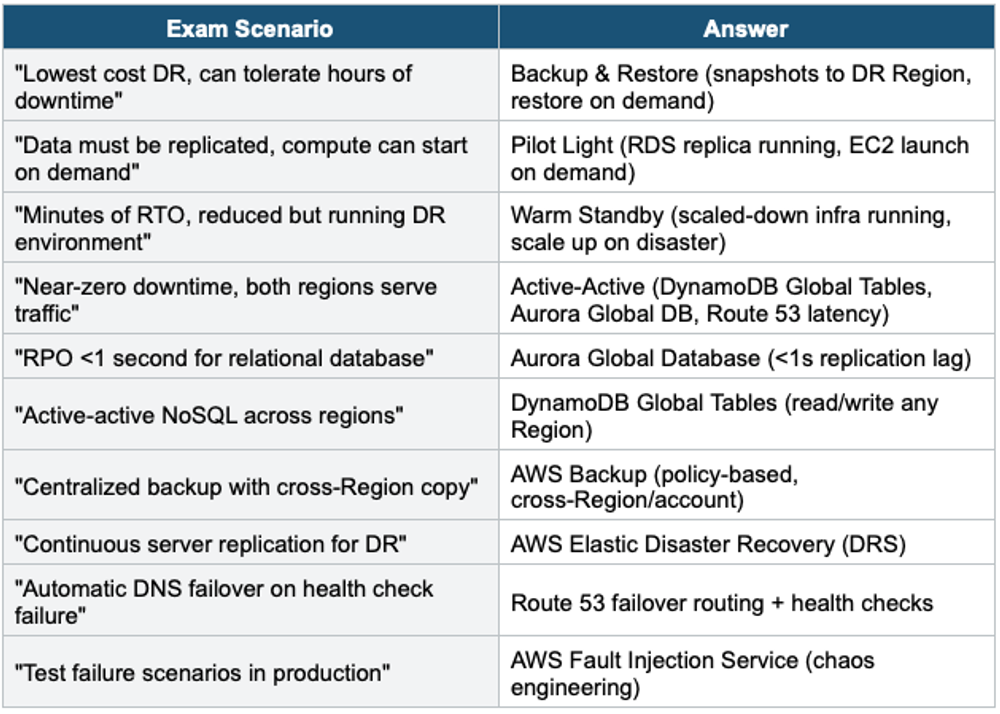
Exam Tip DR Strategies: "Lowest cost" = Backup & Restore. "Core data replicated, computed off" = Pilot Light. "Scaled-down running" = Warm Standby. "Both active" = Active-Active. RPO = data loss tolerance. RTO = downtime tolerance. Lower RPO/RTO = higher cost. "RPO <1s relational" = Aurora Global DB. "Active-active NoSQL" = DynamoDB Global Tables. "Centralized backups" = AWS Backup. "Server replication for DR" = DRS. Always match strategy to RPO + RTO + budget requirements.