1. What is Event-Driven Architecture?
In event-driven architecture (EDA), components produce and consume events. Services are decoupled: producers don’t know about consumers, and vice versa. Events flow through a broker (EventBridge, SNS, SQS, Kinesis) to interested subscribers.
Core Concept Traditional: Service A calls Service B directly (tight coupling). Event-Driven: Service A emits an event ("order created"). EventBridge routes it. Services B, C, and D each react independently. If Service B fails, A and C are unaffected. EDA enables: loose coupling, scalability, and extensibility (add consumers without changing producers).
2. Event-Driven Services on AWS
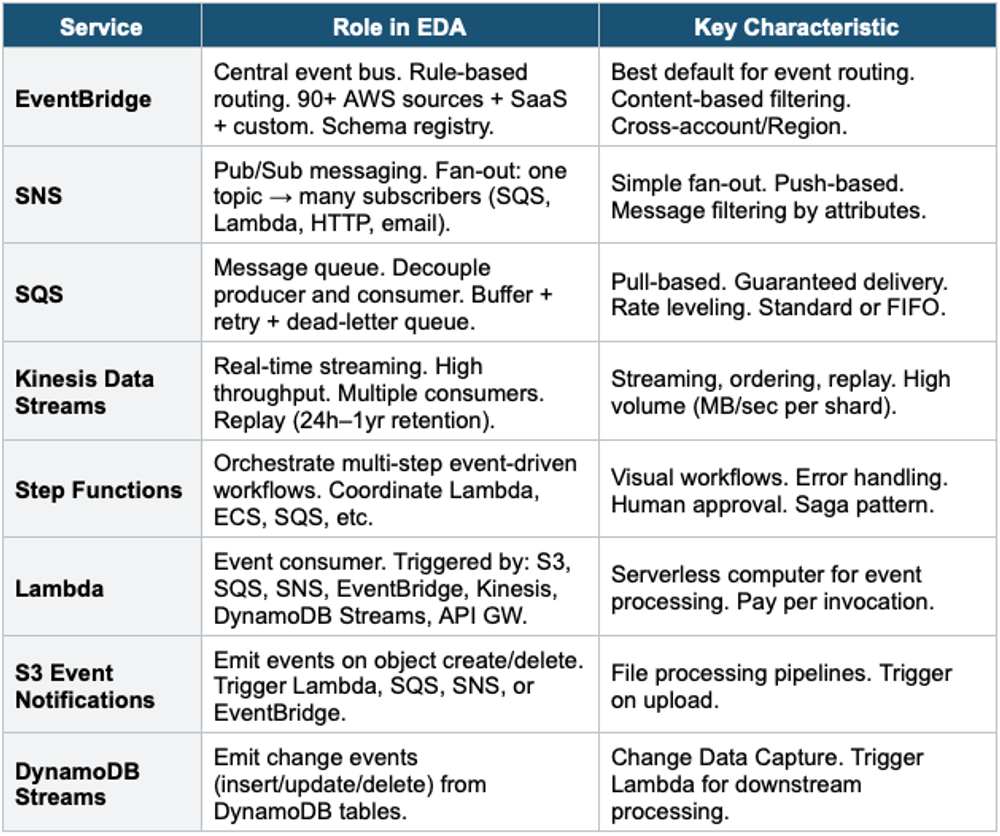
3. Common EDA Patterns
Pattern 1: Fan-Out
Fan-Out (SNS → Multiple SQS):

  Order Service emits: "OrderCreated."
       |
  SNS Topic: order-events
    |─── SQS: inventory-queue  → Lambda (update inventory)
    |─── SQS: payment-queue   → Lambda (process payment)
    |─── SQS: analytics-queue → Lambda (update dashboards)
    └─── SQS: email-queue     → Lambda (send confirmation)

Each consumer is independent. Adding a new consumer = adding a new SQS subscriber.
Pattern 2: Event Bus Routing
EventBridge Routing:

  Multiple Producers:
    Order Service → event: {source: 'orders', detail-type: 'OrderCreated'}
    User Service  → event: {source: 'users',  detail-type: 'UserRegistered'}
    Payment Svc   → event: {source: 'payments', detail-type: 'PaymentFailed'}
       |
  EventBridge (default bus or custom bus)
       |
  Rules route by content:
    Rule 1: IF source='orders' AND detail-type='OrderCreated'
            → Target: Lambda (fulfill order)
    Rule 2: IF source='payments' AND detail-type='PaymentFailed'
            → Target: SNS (alert team) + SQS (retry queue)
Pattern 3: Saga (Distributed Transactions)
Saga Pattern with Step Functions:

  Problem: Order requires inventory + payment + shipping.
           If payment fails, you must compensate (rollback inventory).

  Step Functions Workflow:
    Step 1: Reserve Inventory (Lambda)
      → Success: Step 2
      → Failure: END (nothing to compensate)
    Step 2: Process Payment (Lambda)
      → Success: Step 3
      → Failure: COMPENSATE → Release Inventory (Lambda)
    Step 3: Arrange Shipping (Lambda)
      → Success: END (order complete)
      → Failure: COMPENSATE → Refund Payment + Release Inventory

  Saga = each step has a compensating action for rollback.
Saga Pattern Distributed transactions across microservices are hard (no global ACID). The Saga pattern solves this: each step either succeeds and moves forward, or fails and triggers compensating actions to undo previous steps. Step Functions is the ideal AWS service for Saga orchestration.
Pattern 4: CQRS (Command Query Responsibility Segregation)
- Separate WRITE model (commands) from READ model (queries)
- Write: DynamoDB (optimized for writes)
- Read: DynamoDB Streams → Lambda → OpenSearch or ElastiCache (optimized for reads)
- Benefits: scale reads and writes independently, optimize each for its workload
- Use for: high-read applications, complex search requirements, different read/write patterns
Pattern 5: Event Sourcing
- Store all state changes as an immutable sequence of events (not current state)
- Kinesis or DynamoDB as an event store. Rebuild the current state by replaying events.
- Benefits: complete audit trail, replay for debugging, temporal queries
- Use for: financial systems, audit-heavy domains, event replay requirements
4. EventBridge vs SNS vs SQS
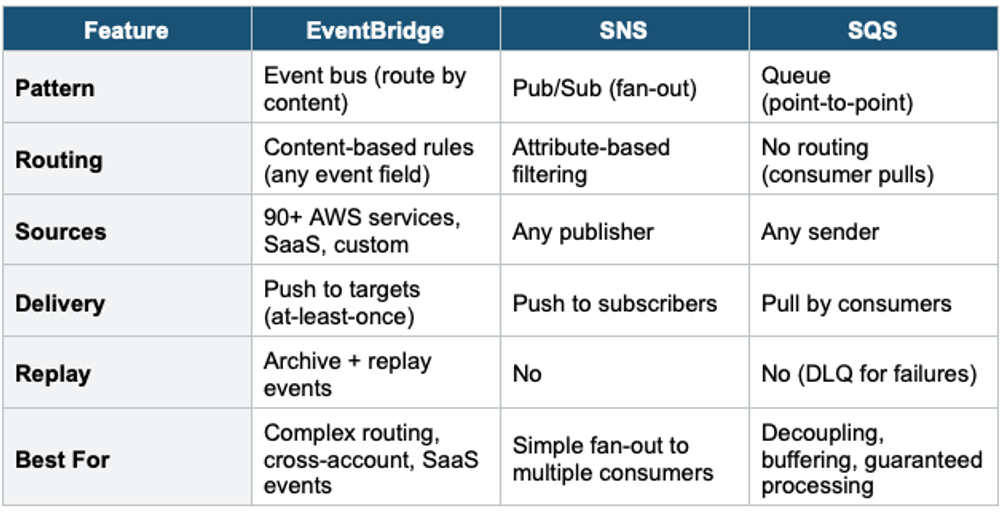
Exam Tip EDA: "Event routing with rules" = EventBridge. "Fan-out one-to-many" = SNS → SQS. "Decouple + buffer" = SQS. "Streaming + replay" = Kinesis. "Saga / distributed transactions" = Step Functions. "CQRS" = separate read/write stores. "Event on S3 upload" = S3 Event Notification. "DynamoDB change events" = DynamoDB Streams. EventBridge = default choice for event-driven patterns.