1. Route 53 Overview
Amazon Route 53 is a highly available, scalable DNS web service. It performs three main functions: domain registration, DNS routing, and health checking. It is a global service with a 100% availability SLA.
Three Functions 1) Domain Registration: buy and manage domain names (example.com). 2) DNS Routing: translate domain names to IP addresses using routing policies. 3) Health Checks: monitor endpoint health and route traffic away from unhealthy resources. Route 53 is the only AWS service with a 100% availability SLA.
2. DNS Record Types
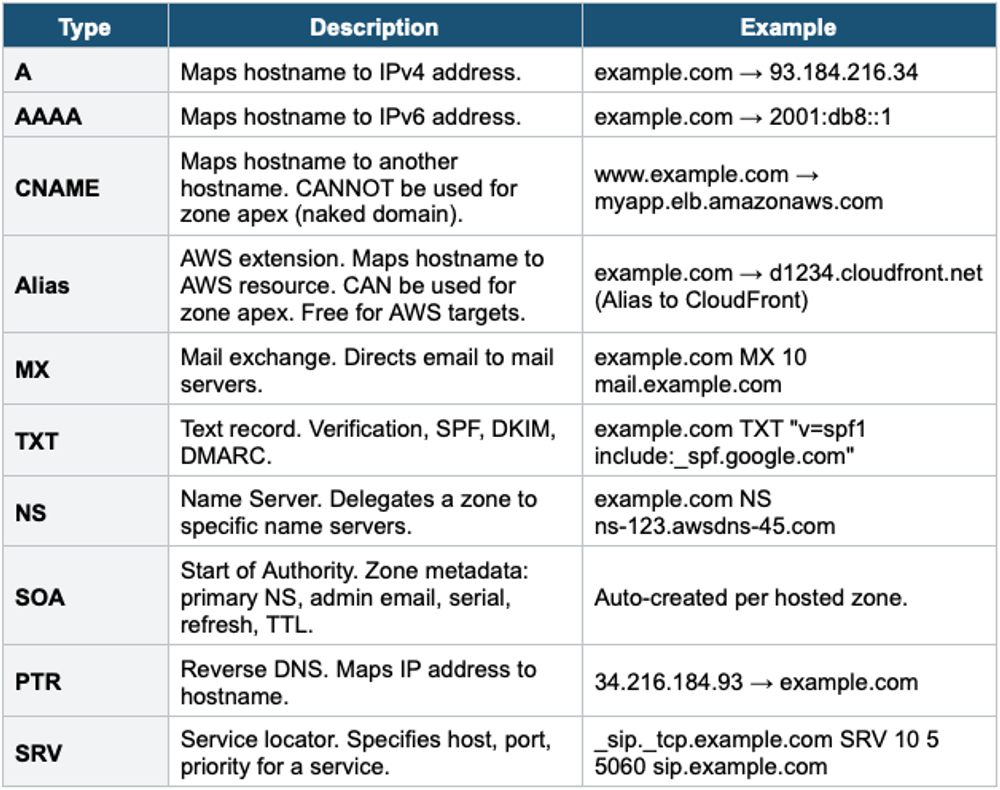
CNAME vs Alias CNAME: maps name to name. CANNOT be used on zone apex (example.com). Costs per query. Works with any DNS provider. Alias: AWS-specific. CAN be used on zone apex. FREE for AWS resource targets. Auto-detects IP changes. Supports: ELB, CloudFront, S3 website, API Gateway, Beanstalk, Global Accelerator, VPC Endpoint, another Route 53 record. Exam rule: "zone apex" or "naked domain" = use Alias, NOT CNAME.
3. Hosted Zones
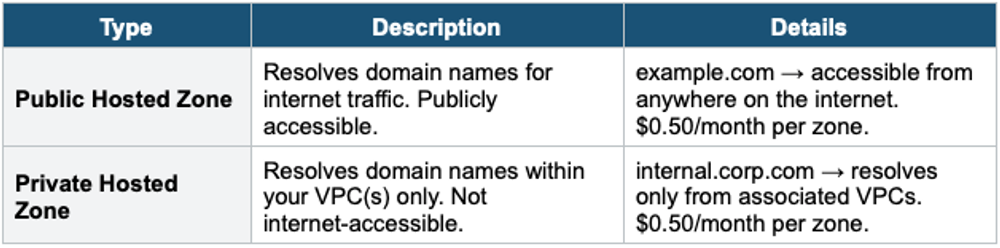
- Private hosted zones: must be associated with one or more VPCs
- Cross-account: share private hosted zone with VPCs in other accounts via CLI/API (not Console)
- Split-view DNS: same domain name, public zone returns public IPs, private zone returns private IPs
Split-View DNS:

  Public Hosted Zone (example.com):
    app.example.com → A record → 54.1.2.3 (public ALB)

  Private Hosted Zone (example.com, associated with VPC):
    app.example.com → A record → 10.0.1.50 (internal ALB)

  Result: internet users reach public ALB.
          VPC instances reach internal ALB. Same domain name.
4. Routing Policies
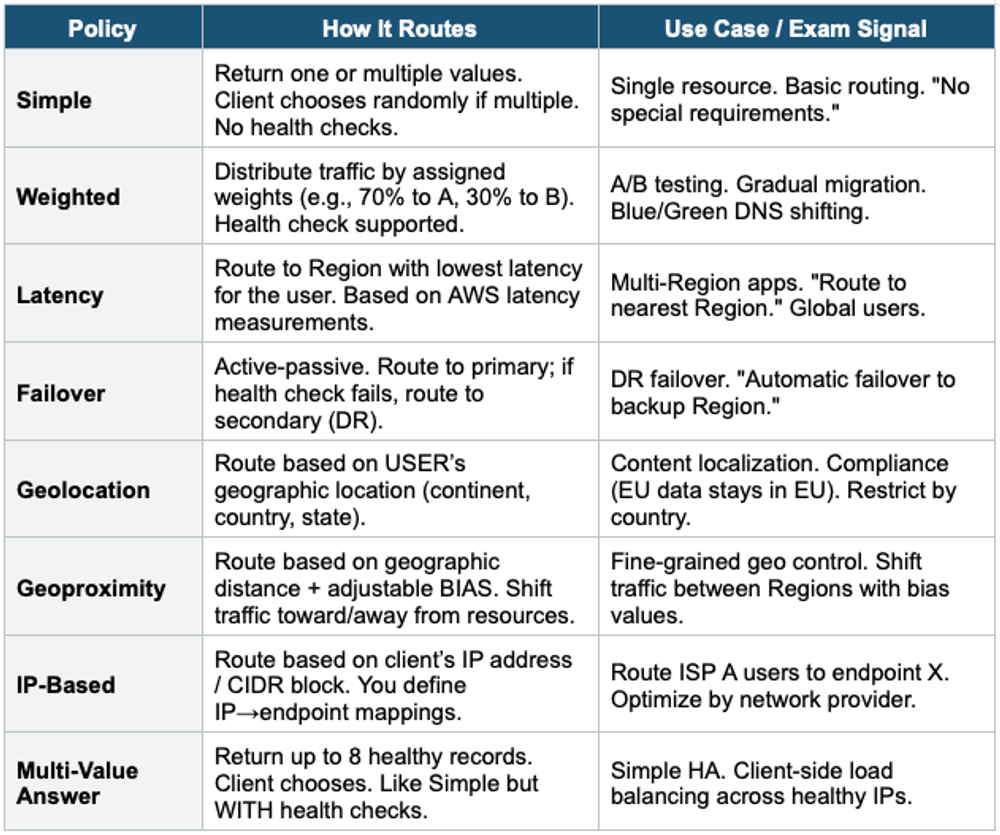
Routing Policy Exam Decision Guide
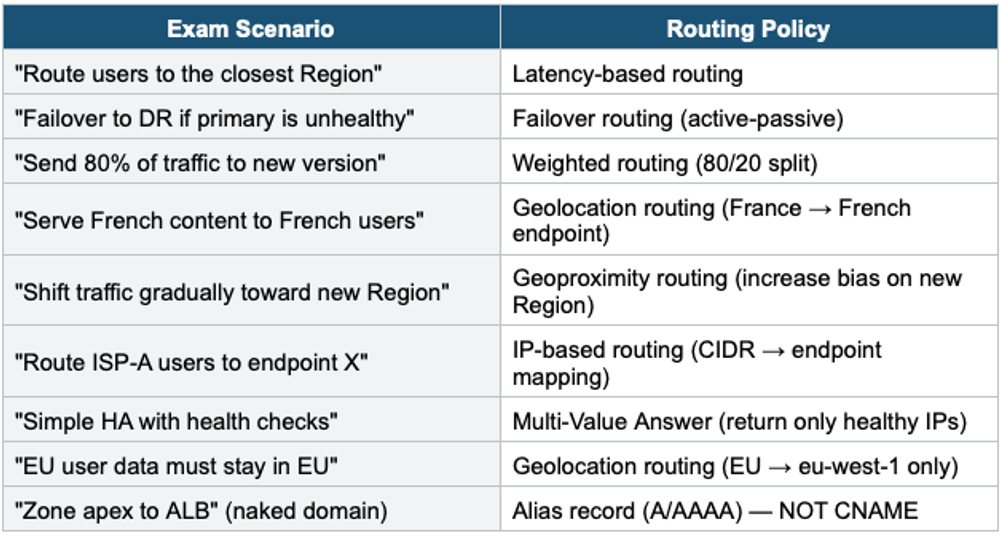
5. Health Checks
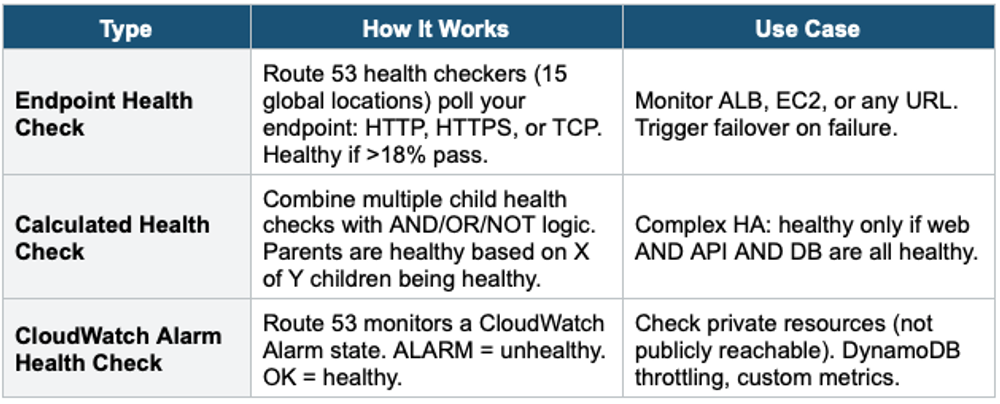
- Health checks can trigger: Route 53 failover routing, SNS notification, CloudWatch Alarms
- Intervals: 30 seconds (standard, free) or 10 seconds (fast, extra charge)
- String matching: check if response body contains specific text (up to 5,120 bytes searched)
- Failover latency: ~30–60 seconds after health check detects failure + DNS TTL for clients to update
6. Route 53 Resolver
Route 53 Resolver handles DNS resolution within your VPC and enables hybrid DNS between AWS and on-premises networks.
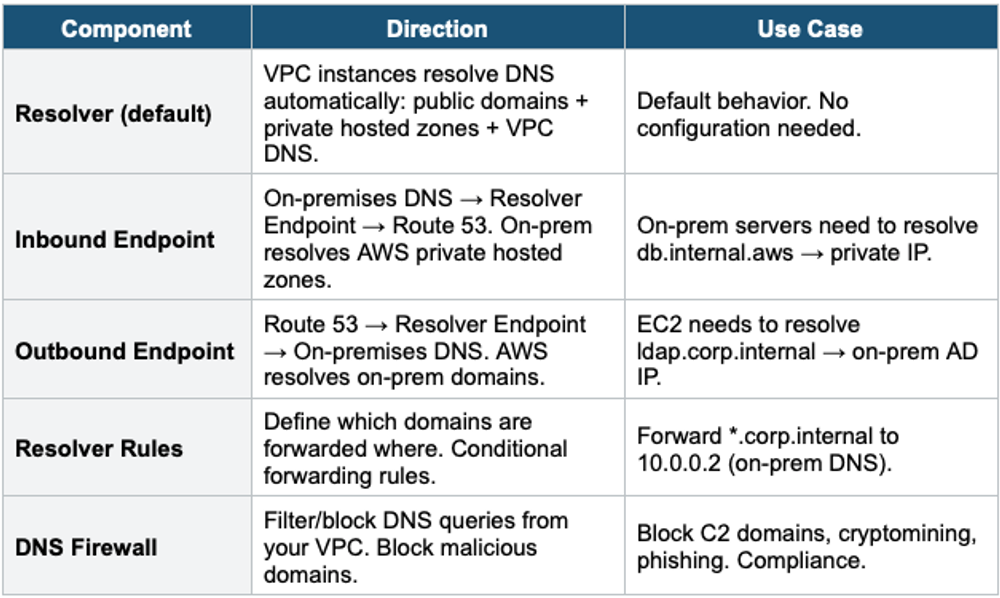
Resolver Rules Sharing
- Share Resolver Rules across accounts using AWS RAM (Resource Access Manager)
- The central networking account creates rules and shares to all accounts in the organization
- Consistent DNS forwarding across all accounts without duplicate configuration
7. Route 53 DNS Firewall
- Filter outbound DNS queries from your VPC
- Domain lists: AWS managed (malware, botnet, C2 domains) or custom lists
- Actions: ALLOW, BLOCK (return NXDOMAIN or custom response), ALERT (log only)
- Associate firewall rule groups with VPCs
- Integration: query logs to CloudWatch Logs, S3, or Kinesis Firehose
- Use for: block DNS exfiltration, prevent connections to known-bad domains, and compliance
DNS Firewall Example:

  Rule Group: "SecurityBlocking"
    Rule 1: AWS Managed List (malware domains) → BLOCK
    Rule 2: AWS Managed List (botnet C2)       → BLOCK
    Rule 3: Custom List (competitor.com)        → BLOCK
    Rule 4: Custom List (*.internal.corp)       → ALLOW
    Rule 5: Default                             → ALLOW

  Associated with: VPC-Prod, VPC-Dev
  Logging: all BLOCK actions → CloudWatch Logs
8. DNSSEC
- DNS Security Extensions: cryptographic signing of DNS records to prevent spoofing
- Route 53 supports DNSSEC for public hosted zones (signing + validation)
- Signing: Route 53 signs your zone’s records with a KSK (Key Signing Key) stored in KMS
- Validation: Route 53 Resolver validates DNSSEC signatures for domains you query
- Protects against: DNS spoofing/cache poisoning (man-in-the-middle)
- Use for: high-security domains, financial services, government
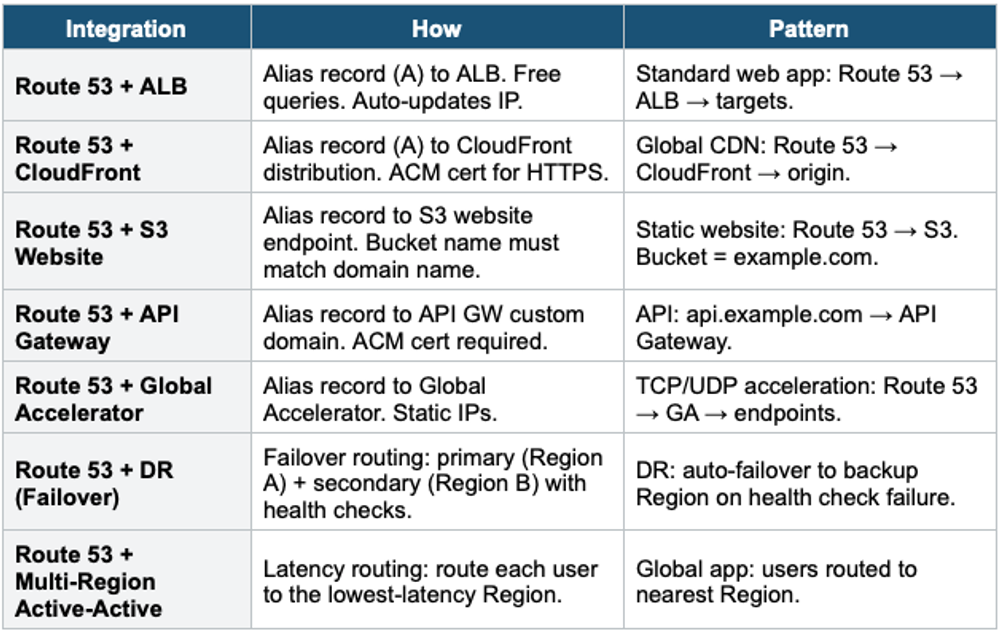
9. Route 53 + Other Services
10. Advanced DNS Patterns
Weighted Alias for Blue/Green
Blue/Green DNS Shifting:

  app.example.com:
    Weighted Alias: 100% → ALB-Blue  (current production)
    Weighted Alias:   0% → ALB-Green (new version, standby)

  Cutover:
    Shift: 90% Blue, 10% Green (canary)
    Monitor errors/latency on Green
    Shift: 50/50, then 0/100
    Final: 0% Blue, 100% Green (Green is now production)

  Rollback: shift weight back to 100% Blue instantly
Complex Routing (Nested Records)
Nested / Chained Routing Policies:

  app.example.com (Failover)
    Primary → app-primary.example.com (Latency)
               └─ us-east-1: ALB-US
               └─ eu-west-1: ALB-EU
    Secondary → app-dr.example.com (Simple)
               └─ S3 static error page

  Result: users route to the nearest healthy Region.
  If ALL primary Regions fail → failover to the static DR page.
  Nesting: Failover → Latency → Alias to ALB.
Important Warning DNS TTL affects failover speed. Low TTL (60 seconds) = faster failover but more DNS queries (higher cost). High TTL (300 seconds) = slower failover but fewer queries. For DR/failover records, use low TTL (60s). For stable records, use a higher TTL (300–900s). Client-side caching may ignore TTL.
Exam Tip Route 53 Advanced: "Zone apex" = Alias (not CNAME). "Route to nearest Region" = Latency. "DR failover" = Failover policy + health checks. "A/B testing DNS" = Weighted. "EU users stay in EU" = Geolocation. "Private resources health check" = CloudWatch Alarm health check. "Hybrid DNS" = Resolver Inbound + Outbound. "Block malicious DNS" = DNS Firewall. "Prevent DNS spoofing" = DNSSEC. "Shift traffic between Regions" = Geoproximity with bias. Alias is FREE for AWS targets. 100% SLA.