1. Definition
Cloud computing is the on-demand delivery of IT resources over the internet with pay-as-you-go pricing. Instead of buying, owning, and maintaining physical data centers and servers, you can access technology services (compute power, storage, databases) on an as-needed basis from a cloud provider like Amazon Web Services (AWS).
Key Definition (AWS Official)
Cloud computing is the on-demand delivery of compute power, database storage, applications, and other IT resources through a cloud services platform via the internet with pay-as-you-go pricing.
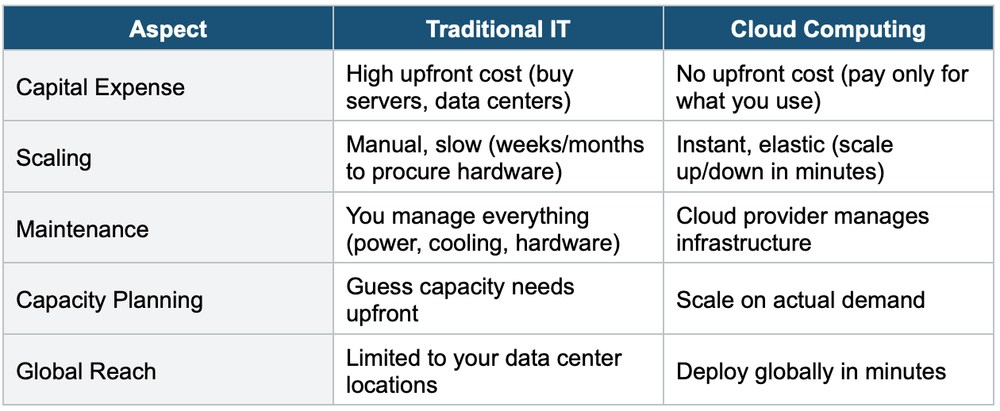
2. Traditional IT vs. Cloud Computing
Understanding the difference between traditional IT and cloud computing is essential for the exam:
3. Cloud Deployment Models
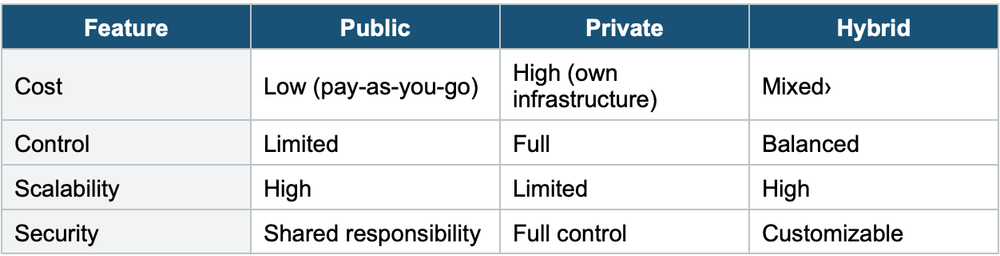
AWS recognizes three main deployment models:
Public Cloud
- Resources are owned and operated by a third-party cloud provider (e.g., AWS, Azure, Google Cloud)
- Delivered over the public internet
- Multi-tenant: multiple customers share the same infrastructure
- Example: Running a website on AWS EC2
Private Cloud (On-Premises)
- Cloud infrastructure used exclusively by a single organization
- Can be hosted on-premises or by a third party
- Offers more control and customization
- Example: A bank running its own OpenStack-based cloud in its data center
Hybrid Cloud
- Combines public and private clouds, allowing data and applications to be shared between them
- Gives businesses greater flexibility
- Example: A company keeps sensitive data on-premises but uses AWS for web-facing applications›
4. Five Characteristics of Cloud Computing (NIST)
The National Institute of Standards and Technology (NIST) defines five essential characteristics:
- 1. On-Demand Self-Service: Users can provision resources (servers, storage) automatically without human interaction with the provider.
- 2. Broad Network Access: Resources are available over the network (internet) and accessible through standard devices (laptops, phones, tablets).
- 3. Resource Pooling: The provider’s resources are pooled to serve multiple customers using a multi-tenant model with different physical/virtual resources dynamically assigned.
- 4. Rapid Elasticity: Resources can be elastically provisioned and released to scale rapidly based on demand. To the user, capacity appears unlimited.
- 5. Measured Service: Cloud systems automatically control and optimize resource use. Usage is monitored, controlled, and reported — providing transparency for both provider and consumer (pay-as-you-go).
Exam Tip
The five NIST characteristics are commonly tested. Remember: On-Demand, Broad Network, Pooling, Elasticity, and Measured Service. A common trick question asks which is NOT a characteristic.